Justice (Deck of Lies, #1)

Get it everywhere online books are sold!

The Tower (Deck of Lies, #2)

Visit the Books page for free samples

Death (Deck of Lies, #3)

Get book downloads on the Free Stuff page

Judgment (Deck of Lies, #4)

Get the boxed set edition to get even more secrets!

Hope's Rebellion

Get it now!

Books on Film: Jurassic Park

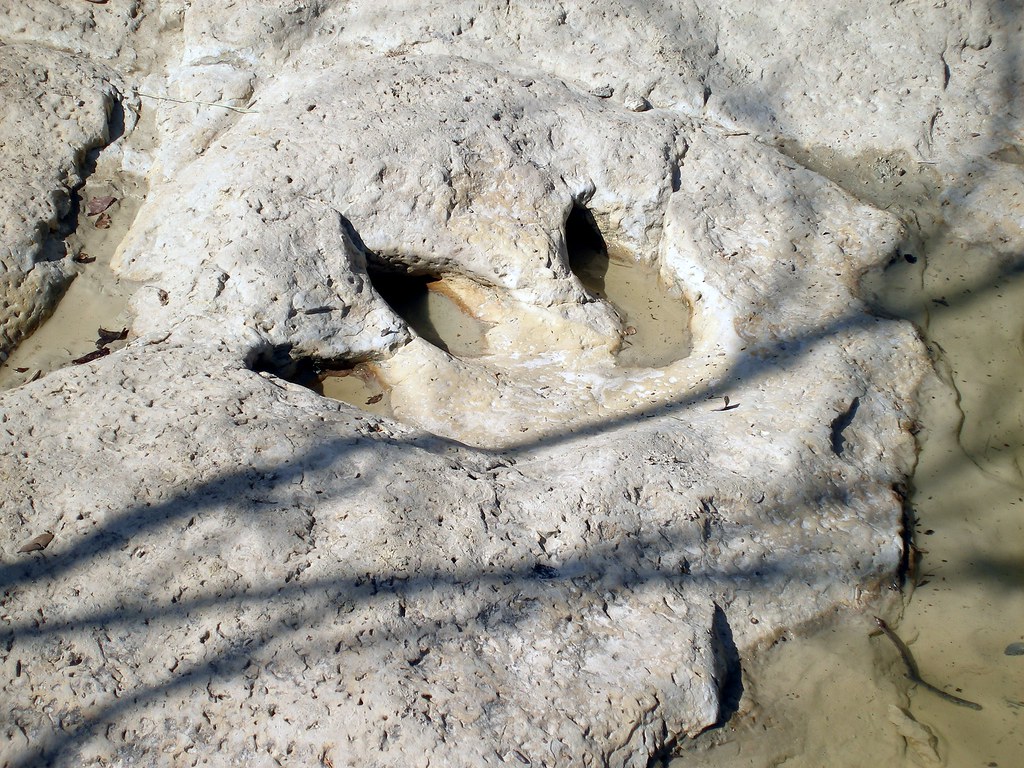
Haven't we all been fascinated by dinosaurs, at one time or another? I remember that, as a child, I was always very concerned about what happened to them. It caused me great distress that scientists couldn't figure it out exactly. And I remember the very first time I saw Jurassic Park on the big screen. You wouldn't think that reading a book about dinosaurs would be as satisfying as watching them up there, but you'd be wrong.

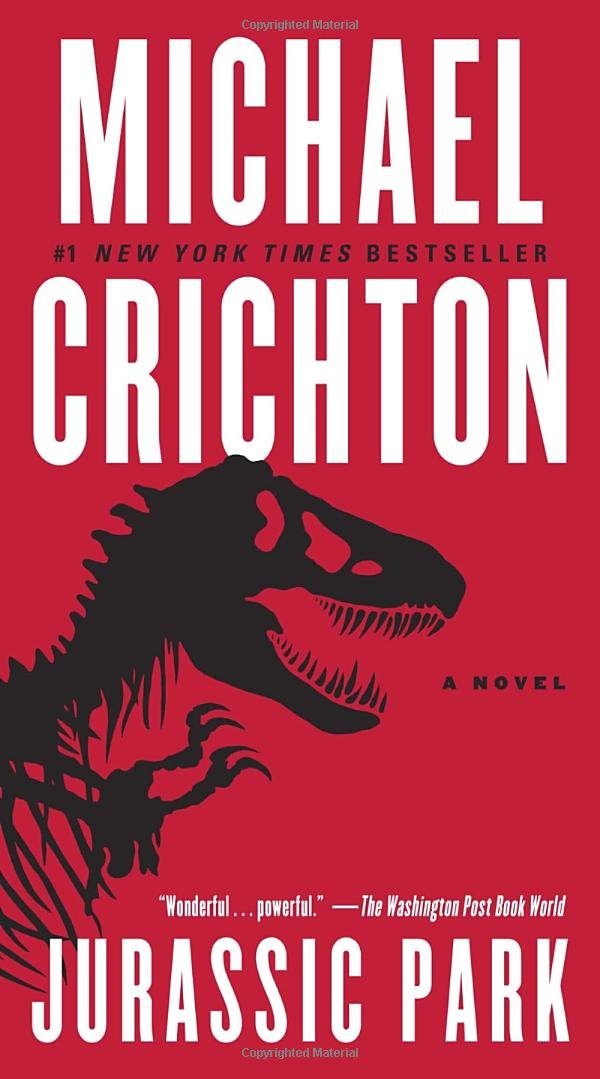
The Book

Jurassic Park was a bestseller n 1990, and so popular it became Michael Crichton's signature book. For an author with a career like his, that's really saying something. The story was always destined to become a movie. Crichton originally envisioned it as a screenplay about graduate students who recreate dinosaurs.

As the project developed, Crichton tweaked this original idea. As it stands now, the story opens in 1989 after a series of strange attacks on Isla Nublar in Costa Rica. In a different part of the world, billionaire John Hammond has paleontologist Alan Grant and his graduate student Ellie Sattler collected so they can be brought to Costa Rica.

When they arrive, they're introduced to Jurassic Park. It's a theme park that's filled with dinosaurs. Actual dinosaurs. They've been cloned from ancient DNA found inside gnats and ticks that were fossilized in pieces of amber. Missing DNA has been filled in by reptiles and birds available in today's modern era. Considering the impossibility of the plot to begin with, this explanation seems like it could be somehow plausible so props to Michael Crichton for that.

Hammond glowingly shows off his state-of-the-art facilities to his guests. He's thought of everything, like engineering all the dinosaurs to be female so they can't reproduce. The two scientists aren't alone on the tour. They're joined by mathematician Ian Malcolm and lawyer Donald Gennaro, who represents the investors. Malcolm particularly thinks the park is a terrible idea, bound for doom.

To round off the tour group, Hammond has invited his grandchildren. This is Tim and Lex Murphy. While this is all happening, there's someone on the inside with an agenda of his own. It's Dennis Nedry, and he's secretly working for a rival genetics firm. Nedry shuts down the computer security systems to steal embryos, which he attempts to sneak out of the park. 

But he did shut off the security systems, and by the way there's a tropical storm brewing. So Nedry is killed by a Dilophosaurus, the tour guests get attacked by a T-Rex and all hell breaks loose. Grant gets lost in the park with the kids, Malcolm is badly hurt and all the redshirts die in the background.

Things get really gory after that. Surprisingly, a lot of the blood was actually toned down for the big screen...but the film is still pretty epic.

The Movie

Jurassic Park hit the big screen in 1993, and everybody went to go see it. The ensemble cast is amazing, the effects were the absolute best of their day and it had Steven Spielberg pointing the cameras so the flick was bound for greatness from the word go. The marketing campaign alone cost a whopping $65 million.


The movie features the same main cast and premise as the book, though some things about the characters were changed for the film version. On film, the dinosaurs are terrifying. The tropical scenery is lush. And the music is practically enough movie all by itself. Jurassic Park earned more than $900 million the first time it was released to theaters and won three Oscars. 

It was a pioneer in visual effects, as both animatronics and computer-generated images were used to create the film. The movie spawned two sequels (the book had only one), and a fourth Jurassic Park is scheduled for release in 2015.

What Got Adapted? 

While major plot points are the same, lots of other stuff was changed to bring Jurassic Park to the big screen. Some of the changes are glaring. Many of the dinosaurs in the film actually didn't even exist during the Jurassic period. The majority of the species you'll see weren't around until the Cretaceous period. The Brachiosaurus and Dilophosaurus are the only two species who were around for the Jurassic period. 


Part of the ending of the story was re-written to feature the T-Rex, whom Spielberg considered to be the star of the movie. The animatronic T-Rex was 20 feet high and a true work of art. The scene where the beast chases the Jeep took about two months to finish.

In the book, Tim is the older child and Lex his younger sister. On film their ages are reversed. According to urban legend, it's because Spielberg was very keen on the child actor who played Tim and wanted him for the role. In the book, he's also the computer whiz and not Lex.

Dr. Alan Grant is not Ellie's love interest in the book, but her teacher. They are not romantic. In the book, the park is already finished. On film, it's not finished and not yet ready to open. Crichton himself has said that the movies are much different from the books. So to get another version of the story, read the original Jurassic Park before you watch the movie for the 50th time.

Writing 101: What #AmazonCart Can Do for Indies

If you're an Amazon customer (and I suspect that you are), you've probably already been spammed with emails regarding the new #AmazonCart hashtag. But if you're like me, you erased those emails. I don't read spam emails, but I do research things that interest me. And if you're an indie author, like me, #AmazonCart should interest you, too.


Not Another Hashtag

In a new partnership with Twitter, Amazon has unveiled yet another way to sell their products: #AmazonCart. If Amazon tweets a link to one of their products, you can simply reply to it with #AmazonCart. Through the magic of the Internet, that item will be added to your Amazon account. But here's the beauty of it: you can reply to anyone who posts a link to anything on Amazon. Yes...including indie books. You don't even have to click a link, just hit reply and you're shopping without leaving Twitter.

Writing 101: Unresolved Subplots

If there's anything that will put me off a novel or book series, it's loose ends. I want every question to be answered, and where appropriate I'd really like to learn the ultimate fate of every single character, ideally. And that's why I don't truck with stories that contain unresolved subplots. Here's why it ought to matter to you: I'm not the only reader who feels this way. 


But What About the Dog? 

Subplots are used to add meat to the main story. They're around to provide excitement, or perhaps mystery, maybe even romance. In the best stories, I find, the subplots are intricately woven around the main plot and all the threads interconnect somehow. When subplots are just hanging out there for no reason, I always feel a bit like my time is being wasted so I appreciate it when everything ties together.

Writing 101: Are You Too Hard on Yourself?

As an indie author, you're in charge. You decide what to publish, when to publish, how the cover will look and how the promotion will go. You're the boss...but you're also your own employee. And every once in a while you need to stop and ask yourself if you're being way too hard on yourself. As an indie author, it's really easy to become your own worst enemy. 


Evil Twin

I'm not a good boss. I know, because I make my only employee work 10 hour days and 7 days a week. She doesn't get holidays off. In fact, she hardly gets any days off -- one a month, so far, in 2014. She has to eat while working and generally only gets negative feedback from me, the boss. My only employee is myself, and I have a habit of being way too hard on myself.

Writing 101: Being Funny

Everybody likes laugh, and that's why writers who can be funny can also do very well. So now it's time to ask yourself: what do you know about being funny? 


So Why Don't You?

Being able to tell a joke well doesn't necessarily make you funny, but it sure as heck doesn't hurt. So if you can tell a joke and other people laugh, then you've got a shot at being funny in your books. You don't have to be a stand-up comedian to be capable of writing a book -- or at least, a book with some funny stuff in it. But you do have to know what it takes to be funny, because some of the same qualities that make comedians good can be translated onto the page.

Writing 101: Everybody Says You Have to Read, Too

As I've mentioned before, I go looking for writing tips all the time. It never hurts to have help, and I don't care who you are. But there's one tip that I just keep on seeing, and seeing, and now I have to address it. Because everybody says you have to read, too. I'm going to tell you what's wrong in that tip. 


When Enough is Enough

I'm not saying that the tip is wrong in entirety. Yes, you should read. It's very important that one understands the mechanics of a novel if one is going to write a novel, this much is clear. And I'll take it even further by saying that you ought to read books across several different genres. It's not at all a bad idea to read classics, mysteries, romances, YA novels, horror novels, fantasy novels and any other darned thing that strikes your fancy.

If you're a lover of words, you're probably going to do all of this anyway. And if you become an indie author, you're probably going to read self-published books as well. But here's where I draw the line: you don't have to read all the time.


Writing 101: Building Suspense

Building suspense is truly a fine art. If you can master it you can craft thrilling stories. But you may also be running your readers around in circles instead. Are you actually building suspense...or are you wasting my time? 


Writing in Circles

There is nothing more deliciously suspenseful than watching an Alfred Hitchcock movie, and knowing that something is about to happen. Sitting on the edge of your seat with your heart pounding, anticipation building and rising. But the thing about a Hitchcock movie is this: it's going to be over in 2 hours. So you know you're going to have to wait...but you also know the wait isn't going to inordinate. When it comes to suspensful novels, it's a whole different game.

Writing 101: Does It Need to Mean Something?

Lately, I've been asking myself a question about books: does it need to mean something? Does a book need to have some sort of merit, a reason for being, or is it okay to simply tell a story? 


What's It All Mean? 

I feel that I've been on both sides of this argument. I believe that, for the most part, people read way too much meaning into books. Even having a certain book in one's possession may carry some sort of meaning. People have been killed, I'm talking about murdered, because of a book. That's taking it too far, and I often say that all books should simply be taken at face value. Quit looking for meaning, just enjoy the story.