Justice (Deck of Lies, #1)

Get it everywhere online books are sold!

The Tower (Deck of Lies, #2)

Visit the Books page for free samples

Death (Deck of Lies, #3)

Get book downloads on the Free Stuff page

Judgment (Deck of Lies, #4)

Get the boxed set edition to get even more secrets!

Hope's Rebellion

Get it now!

Writing 101: The Worst Case Scenario

When I'm afraid of trying something new, I play a little game with myself. I imagine the worst possible outcome and I create an entire plan for how I would deal with it. I figure that if I have a plan for the worst thing, I can handle anything

It doesn't always work. Recently, I was blind sighted by a worst-case scenario I never saw coming. There is something worse than a one-star review from a reader...and it happened to me. 


The Worst of the Worst

Say what you will about Amazon, but at least it makes you write something if you're going to rate a book. Such is not the case with Goodreads, which allows readers to rate books all day without so much as a by-your-leave.

This, my fellow authors, is the worst-case scenario. You know the reader didn't like the book, and that's it. You don't know what they didn't like, or why, or even if they read the whole thing.

Doesn't give you much room to improve, does it? 

This is why it's the worst of the worst, because there's nowhere else to go. You can't learn from it or build upon it. You can't even figure it out unless you contact the reader and ask, an action I do not recommend.

It's truly the worst, but it's not the end of the world. You simply have to ignore it. I know that's hard (I know because I spend so much time staring at my own ratings), but that's all there is. It's a worst-case scenario, but it really isn't so bad.

And now that you can imagine the worst and you have a plan to deal with it, you can handle all the rest. Maybe it's not so hard to be a self-published author after all.

Chaos and Justice

"Rain Ramey's search for herself in the midst of all the chaos drew me in until the very last page."


"Quick and entertaining read, with an interesting set of characters."

Justice (Deck of Lies, #1) has been reviewed by the Intrepid Book Moth! Read the whole thing to find out what the reviewer didn't like about the book.

Writing: Falling in Like

I watched a movie on Sunday. It felt like a big deal because it's one I've been waiting to see since last Christmas. So I watched it...and I hated it. It wasn't necessary the amateurish singing, the casting choices I thought were bad, the inattention to wardrobe or even the lack of dialogue (which is my favorite part of any story). It was the characters. About halfway through, I realized that none of them were likable. I felt really unhappy with every moment of it after that. Making your readers fall in like is essential if you want them to keep being your readers.


The Middle of the Road

Notice I didn't say that readers should fall passionately in love with your characters. That's hard to do for even the most brilliant of writers, and it's polarizing anyway. Think Twilight and Gone With the Wind. Both stories have very strong male leads that make female readers swoon, but the female leads are not well-liked by their reading counterparts. Scarlett O'Hara and Bella Swan are both incredibly unlikable in different ways, and it's only tempered by their way-too-sexy literary co-stars.

I'm not asking you to capture lighting in a bottle...or on the page. You'll have a much better chance of creating a character that's just plain likable. Think Harry Potter. You probably aren't in love with him (I never did like a man with shaggy hair, myself), but you probably like him and want him to win his battles. He's a little bit clumsy and inept at times -- aren't we all -- and he's no romantic hero. He's just a likable guy who makes mistakes but wants to do the right thing.

And he sold billions of books, so don't tell me that likable isn't good enough. It is. By far, likable is a lot better than having characters no one can like. So now it's your job to create characters that people like. For writers, who tend to be introverted loners who are focused on what's happening in their heads, this can easily feel like an insurmountable task. But don't fret -- there's a formula to creating a likable character (and I happen to know what it is).

  • They're relatable: Your character can live on a space station or in a house behind a white picket fence, and still be relatable or not. Make your character one the reader can identify with. Give them flaws, give them dreams, give them fears and hang-ups and crushes and bad memories and inside jokes. Make them feel real, and I will be able to relate.
  • They fail: The reader is supposed to root for the hero to triumph, and that's fine. But sometimes, the hero should fail. People fail sometimes, so people in books should also.
  • They try: Heroes don't have to do the right thing all the time, but they should want to. They should regret it when they do the wrong thing. They've got to try, because that's all anyone can do. Effort makes characters likable.

Your characters don't have to be gorgeous and they don't have to be perfect, because most ordinary people are not these things. They simply have to be real people who attempt to succeed at being good. Do this, and I'll be falling in like with your book.

Passing Judgment

"I LOVEDDDDDDD the courtroom scenes!!! Oh my freakinggggg goodness, it was gooodddddddddddddddd!"


"I am pleased to give not only this book, but the WHOLE series a 5 OUT OF 5 STARS!"

Nourin, friend of the blog and the blogger behind BookAThonFreak, has reviewed Justice (Deck of Lies, #4). Read the spoiler-free review to see how she felt about the conclusion of the series!

Writing 101: Make 'Em Laugh

Some of the most memorable stories end told end with tears. Romeo and Juliet is designed to produce tears, and I became hysterical after I watched Terms of Endearment for the first time. Sadness certainly has its place in storytelling. But please, remember to lighten up sometimes. I should crack a smile, at the very least, during the course of your book...but I'd really like to laugh out loud.


Everybody Loves a Clown

Jokes have always had a way of bringing people together. Certain body muscle relax when you laugh, and sharing laughter with another will put you at ease. Ever sat in a crowded movie theater and heard everyone laugh along with you at the same joke? Laughter inspires camraderie. It's the basis for many friendships and even romantic relationships. 
It's great stuff, and that's why you've got to make an attempt to add some humor somewhere to your book. What if you're writing a gritty drama, a serious tragedy, a tear-soaked epic? 

To my way of thinking, that's when you need laughter the most. 

Even tragedies need a little laughter, because nobody can be serious all the time. A joke here and there will alleviate tension. You cannot keep constant pressure on your readers, or they'll break. It's a pretty simple law of physics. If you place a bowling ball on top of a wicker basket and start to press down, that basket will buckle and break if you don't ever relieve the strain. But if you let up every once in a while and let that basket bounce back, you can go right back to applying pressure.

Take a similar approach with your readers. Put the screws to them. Drag them through emotions. Make them cry. But every so often, lighten up. Give them a joke, give them a laugh, give them a bit of a breather -- and then you can go right back to the tension. Your writing will be better for it, and your readers will be far, far more tolerant because of it. 

So make 'em laugh...at least, every once in a while -- and make them keep reading.

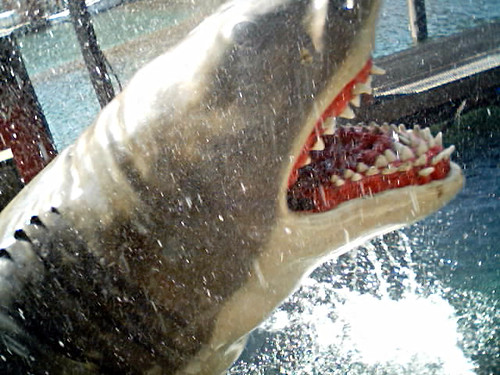
Books on Film: Jaws

Jaws became one of the most famous big screen villains, a predator so frightening he has his own theme music. But before he swam onscreen, Jaws lived on the page.


The Book

Peter Benchley wrote Jaws in 1974, and changed horror. He was inspired by real shark attacks to write the book, though it sure didn't hurt that Doubleday asked him to pen the story.

It was so good, it was destined to become a film even before it was finished. Two producers read it before the book was even published, and quickly purchased the film rights. They helped the book become a bestseller. The very next year, in 1975, it became a hit movie. 


Jaws is set in fictional resort town Amity in New York. A young girl is attacked and killed by a shark while on vacation, but its buried by the Mayor and a local newsman so as not to disturb the town's appeal as a tourist destination.

But the killing doesn't stop. A local fisherman disappears after being asked to go kill the shark, an action prompted by the beast's attack on two local residents. The local chief of police, Brody, pulls a huge shark tooth out of the fisherman's boat. It's all that's left of the fisherman (Ben).

We learn that the Mayor is in collusion with the mob to keep the beach open (and the property values high), and the chief's wife has an affair with the fish expert who is brought in, a guy named Hooper. By the way, Jaws has a lot of sub-plots that were cut on film.

The chief decides to take action when the tourist population swells. People are flooding Amity instead of running away, as expected. They're hoping to see the killer shark. Brody hires himself a shark hunter, a guy named Quint. Together with Hooper, the men set out on Quint's ship the Orca to hunt the beast themselves.

It's tense. Brody suspects the affair, Quint is a loose cannon and Hooper seems to enjoy goading Brody. For days they find nothing, see nothing.

But they eventually find the shark, and Hooper dies in an attempt to capture it. Brody is now out of money, but Quint no longer cares. Hunting the shark is all that matters.

He gets his wish, and Jaws dies in a thrilling action scene, but the shark takes Quint with him.

The book was on the bestseller list for 44 weeks. Jaws became part of cinematic history for ever. Later in life, Benchley felt guilty for giving sharks a bad rap and became an activist.

The Movie

Director Steven Speilberg didn't like the characters in the book, and wanted the shark to win. On film, Roy Scheider stars as Brody, Richard Dreyfuss as Hooper and Robert Shaw as Quint the shark hunter.

They had problems making the flick right away. Filming went over budget and past schedule. The mechanical sharks kept breaking, so Speilberg had to get creative. Instead of the shark, there are a lot of shots of the water, backed up by the famous score composed by John Williams. 


It made for a thrillingly terrifying film, and moviegoers responded accordingly. Jaws became the highest-grossing film of its day, and the first summer blockbuster. Three sequels followed, though Benchley and Spielberg were not involved.

Spielberg removed many of the subplots, because he said the shark hunt was his favorite part. He made the characters more likable, got rid of the affair and brought in new writers to rework the script after Benchley turned in three rewrites.

As a result, the film focuses more on the shark than on the people, a deviation from the novel that made Jaws a big screen legend. Spielberg and his fleet of writers took heavy poetic license with the script, but it's hard to complain at the final result. The movie is chilling, action-packed, and it ushered in a new era of glossy big-budget films that we still celebrate today. But purists will note many, many differences when comparing the two.

What Got Adapted? 

The trouble in Brody's relationship with Ellen is obvious early in the novel, when they argue because she's so unhappy with her life with him. In the film, they're amicable with each other. Hooper in the book is a bit of a snobby elitist, an Ivy Leaguer who isn't likable once. Richard Dreyfuss as Hooper is impossible not to like. 

The Mafia subplot is abandoned in entirety, newspaper reporter Harry Meadows is shoved to the fringes of the story, and Brody never tries to strangle Hooper to death on the deck of the Orca. The illegal dolphin bait is exchanged for standard chum on film, and the Orca stays on the oceans for many days and nights (in the book, it returns to dock at night). 

One of the most noticeable differences is Hooper. He dies in the cage on the page, but survives the ordeal on film. Quint's death is changed. In the book he dragged under water when his foot is caught in the harpoon rope. The shark eats him on film. Even the shark dies more dramatically on film, but then it's a visual medium.

Surprisingly, it's the book that's the darker of the two. Spielberg hired comedy writers to lighten up the script and add some jokes in order to balance out the life-and-death struggle that plays out in the story. On paper, Jaws reads like a whole different story altogether. Give it a try after you watch the movie...and think about it next time you go swimming.

Writing 101: Strings Attached

What are you willing to do to get exposure for your book? There are people out there who hope you'll do just about anything. Give them a chance, and they'll use you for their own ends.

But maybe that's only fair...because aren't you using them?


Quid Pro Quo

I'll scratch your back if you scratch mine. This is a well-known expression, so common in fact it's hardly even considered. But let's consider it, shall we?

By definition, a favor is given freely without promise of recompense. Yet many indie authors are asked to give something in return for receiving book reviews. This takes many forms -- some more overt than others.

Tying to get book reviews? Be careful. Sometimes there are strings attached.

  • Exchange
The review exchange is a common thing between indies. Review my book and I'll review yours. Some authors openly solicit this arrangement, while others use book blogs.

It's no secret that I dislike exchange agreements. There is a certain obligation to give a good review, and fear of repercussion if you do not. But mostly I hate them because they trap you. You may unknowingly agree to read a book that's offensive or poorly written. You can't back out...not if you want a review.

  • Pay Up
You are always expected to provide your books for free to get reviews. But sometimes the reviewer asks for more. Namely, money.

It's happened to me and it'll happen to you, too. You may be asked to pay for reviews. I caution you not to do this. The review may not be fairly written, and even if it is it will always be suspect to readers. Plus, you don't need to spend your money on reviews. Save it for promotion. 

  • Promote
There's always a sort of unwritten rule that when a blogger writes you a review, you promote it on all your sites. That means social media, too. It isn't usually part of the agreement, bit it is a standard courtesy. It's also just good marketing...when the review is good,anyway. 


There are always strings attached, though sometimes they're a bit more visible. Use them to create strong ties to the bloggers you like and admire, and develop a relationship. You'll need them again and again.

Writing 101: What Are Your Responsibilities as a YA Author?

Every writer wrestles with themselves. Does that sentence make sense? Is this character relatable? Should I add that cliffhanger? Authors struggle with questions. Now, I'm going to dissect the one that's always on my mind.


Wait...Can I Write That?

I write YA books that feature teenage main characters. As such, I often ask myself what sort of responsibilities I have to my audience.
  • Sex: Personally, I'm extremely uncomfortable writing about it. But the reality is, teens do have sex. If you write about it in your YA books, I encourage you to write about safe sex.
  • Drugs: Teens also do drugs, sometimes. Many fine books look at this frankly, and there's nothing wrong with that. However, you do a disservice to your readers if you don't show the real consequences of drug abuse. It can be life-threatening. Do not make light of it.
  • School: I read this great YA blog, and lately they've been running an ongoing feature about the many cliches in YA books. One of them is teens who don't ever go to school, or even think about it. Your teen characters should be going to school. If they ditch, if they do poorly, they should face repercussions. Don't you when you shirk your responsibilities? 
  • Underage drinking: It happens. There are entire movies about teenagers buying alcohol to have parties. But drinking to excess at any age can be dangerous and it can lead to problems (like hangovers, and fatal car accidents). So if you show it in your books, do so three-dimensionally. Always strive to show all sides of a situation; this makes for better writing anyway.
Like it or not, as a YA author you have to be a bit of a role model. You have a responsibility to your audience. I realized this for myself after I exchanged emails with a mom. Her daughter read one of my books and enjoyed it, so the mom read it, too. During the course of our email conversation, she mentioned that her daughter had a habit of adopting weird (potentially unhealthy) dieting habits from the books she reads. Teens pick up on all those little details you write. What if one of them leads them into behavior that they don't even know is bad for them?

You've decided to speak directly to young readers with your stories. When you do so, think carefully about exactly what you're saying to them. You always have a responsibility to your readers as an author, no matter how old they are. Do your best to wear that responsibility well.