Posts

First Review for Judgment

Image
"I LOVED LOVED LOVED this entire series! BUT I love the ending best of all!!" "It is everything I could have asked for (had I known what to ask for) in an ending!!"  Theresa at Keepin' Up with the Joneses has reviewed Judgment. It's got spoilers! If you've read the Deck of Lies, go check it out.

Books on Film: A Christmas Story

Image
Since its original release in 1983, A Christmas Story has become one of the best-loved and most popular holiday films of all time. Most people don't even know that it's actually based on a book of short stories, written by a guy who actually lived it.   The Book Jean Shepherd published In God We Trust, All Others Pay Cash in 1966. It's a semi-autobiographical collection of humorous short stories, and many of them were used to inspire the full-length feature film A Christmas Story . In the book, Shepherd writes about his hometown in Indiana, his friend Flick, and the longing he had to own a real Red Ryder BB gun. And in the book, Ralphie is all grown up. He has returned to his hometown, where he finds Flick at the bar he inherited from his father. They talk about the "good old days" together, and this is where we get most of the stories that unfold in the book.  The book goes far behind a single holiday season, and in fact there's one story...

Writing 101: Can You Define Irony?

Image
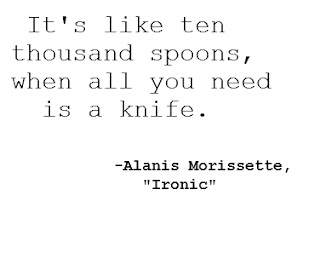
Some words are commonly misspelled by writers. Personally, I can't seem to wrap my head around "lieutenant." Some word pairs are mixed up. I can never keep "affect" and "effect" straight, myself. But some words are just used the wrong way...all the time. Ironic , and all its versions, is one of those words. Defining Irony There's a movie that I love, a romantic comedy with Winona Ryder and Ethan Hawke, named Reality Bites . I love the film because it's true, it does, and Ben Stiller brings a ton of comedic value to the flick. There's a scene in the movie where Ryder's character is put on the spot, and asked to define irony. She makes a few attempts and then cries out that she can't define it, but "I know it when I see it!"  But she probably doesn't. Many people can't define irony, and many writers can't use the word the right way, either. It's a very hard concept to define, but not impossibl...

Writing 101: Hashtags

Image
If you aren't using hashtags, you're not marketing as strongly as you could be. If you think they're too juvenile or just there to waste space, think again. You're a self-published author. When it comes to marketing, nothing is beneath you.  Why You Need Hashtags Twitter hashtags function as internal links. You can use the search bar near the top of the page to search for any hashtag phrase, any time, and see who has written tweets using that phrase. This is a great way to find people who like the same movies, books and music as you. It's also a great way to connect with your reading audience. There's really just one simple reason why you need to use hashtags: everyone else is using them. Once you start, it'll be easier for readers to find you.  The Hashtags You Need But there's an etiquette that comes with using hashtags. You can't write a tweet promoting your book, for instance, and then tack a random hashtag to the end of the mess...

Writing 101: Who's Whose?

Image
Who is a deceptively simple word. It sits there with its three letters, taunting and teasing you. But give in to its siren song of sweetness, and you're going to make all sorts of grammatical errors. There are so many different versions of the word who , you practically need a degree just to keep them sorted. One of the easiest errors to make in writing is mixing up who's and whose . I'm probably going to do it in this post, it's so easy. But together, maybe we can get it straightened out.  Whose Word is it, Anyway? Whose is the possessive form of who . This is confusing, because usually who's would show possession. If I grab ahold of Joseph and grip around his bicep, I'm holding Joseph's arm. The apostrophe and the s show the possession.  That's not how it works with who . The word is irregular, so it becomes whose instead. It's also confusing because either word can properly start a sentence. Let's look at some examples: ...

Writing 101: The Fatal Flaw

Image
You have never met a perfect person. Even that fashionable girl with all the right accessories, or that Adonis who buys a latte every morning and somehow still has washboard abs, is flawed. All human beings are flawed. That's why the characters you create on the page have to be flawed, too. Nobody's Perfect Some flaws are pretty common, and relatively small. Your character might bite their nails, or forget to put their keys somewhere safe. Maybe they lose their phone a lot, I don't know. If you're writing a well-crafted character , you're writing one that has flaws. But many authors take this one step further. Many authors use an important plot device to move their stories forward. Many writers create characters with a fatal flaw.  Fatally Flawed There's a school of belief that says we all have at least one terrible flaw, something that keeps us from being happy or achieving our goals or just moving forward in life. A fatal flaw is ...

Regarding Justice

Image
"The unfolding of characters motives, histories and discoveries of lies were just fun! I wanted to know what happened  next."  "The writing was fast paced and descriptive without being overbearing." Justice (Deck of Lies, #1) has been reviewed at The Readers Heartstring . Read the whole thing before you get your copy of the book!

Books on Film: The Grinch

Image
In late November and all through December, holiday-themed movies flood the theaters. People want feelgood stories, intense dramas, laughter and action. They want to be entertained , and they're doing it indoors because it's winter and it's cold. Filmmakers need holiday-themed stories to create all those movies. One of the most unusual picks, and one of the better book-to-film adaptations you'll find, was created by Dr. Seuss. The Book Arguably the most well-known children's book author of all time, Dr. Seuss has created unforgettable stories like Green Eggs and Ham , The Cat in the Hat and 1957's How the Grinch Stole Christmas , a holiday-themed treat starring my very favorite color, green.  It's because the Grinch is green. He's the hero, or anti-hero, of the story, and he's a good one. He lives on a mountain above Whoville, where Christmas is celebrated with gusto. The Grinch hates the Whos. They sing, they dance, they exchange p...