Justice (Deck of Lies, #1)

Get it everywhere online books are sold!

The Tower (Deck of Lies, #2)

Visit the Books page for free samples

Death (Deck of Lies, #3)

Get book downloads on the Free Stuff page

Judgment (Deck of Lies, #4)

Get the boxed set edition to get even more secrets!

Hope's Rebellion

Get it now!

Writing 101: Who's Whose?

Who is a deceptively simple word. It sits there with its three letters, taunting and teasing you. But give in to its siren song of sweetness, and you're going to make all sorts of grammatical errors. There are so many different versions of the word who, you practically need a degree just to keep them sorted. One of the easiest errors to make in writing is mixing up who's and whose. I'm probably going to do it in this post, it's so easy. But together, maybe we can get it straightened out. 


Whose Word is it, Anyway?

Whose is the possessive form of who. This is confusing, because usually who's would show possession. If I grab ahold of Joseph and grip around his bicep, I'm holding Joseph's arm. The apostrophe and the s show the possession. 

That's not how it works with who. The word is irregular, so it becomes whose instead. It's also confusing because either word can properly start a sentence. Let's look at some examples:

Who's that sitting in our driveway?

Whose pork chop was left in the sink? 

In the first example, I'm asking asking about "who is." I don't know the name of the person in the driveway, so I'm asking "who is that." With who, the apostrophe s is a contraction. The apostrophe is there to represent the i in is

In the second example, I'm asking who left that pork chop in the sink. Who owned this pork chop? Whose was it? I don't know the name of the person with the pork chop, so I'm using who, and I'm asking about something that belongs to who. The word becomes possessive, and it becomes whose. Who's can mean who is or who has, but it can't show possession. It's always a contraction. 

And sometimes, maybe you're supposed to use whom, which is something else altogether. Whom is yet another form of who, and it basically boils down to this: whom is used when the subject is an object, who is used when it's a person.

Don't which know goes where? Just add your is. If you see who's, change it to who is and read it that way to yourself. If it sounds utterly wrong, you probably need to use the word whose instead. 

Writing 101: The Fatal Flaw

You have never met a perfect person. Even that fashionable girl with all the right accessories, or that Adonis who buys a latte every morning and somehow still has washboard abs, is flawed. All human beings are flawed. That's why the characters you create on the page have to be flawed, too.


Nobody's Perfect

Some flaws are pretty common, and relatively small. Your character might bite their nails, or forget to put their keys somewhere safe. Maybe they lose their phone a lot, I don't know. If you're writing a well-crafted character, you're writing one that has flaws. But many authors take this one step further. Many authors use an important plot device to move their stories forward.

Many writers create characters with a fatal flaw. 

Fatally Flawed

There's a school of belief that says we all have at least one terrible flaw, something that keeps us from being happy or achieving our goals or just moving forward in life. A fatal flaw is a mistake that we repeat again and again and again, some characteristic that leads us into mishaps, failed relationships and ugly situations. I have many fatal flaws. 

Does your main character have one?

Characters who have a fatal flaw exhibit the same behavior repeatedly, continuously making the same mistake. The mistake may not necessary repeat itself in the exact same way. A character who talks too much and reveals too much, for instance, may shoot their mouth off in class one day. The next week, maybe they go on a Twitter rant. It's two sides of the same flaw. Many characters are written with fatal flaws as part of their make-up for one simple reason: to eventually beat it

At some point, the character who has a fatal flaw begins to learn from their repeated mistakes. At some point, they start to see their own pattern and actively fight against it. The moment of greatness comes when the character is faced with a situation which would ordinarily bring out their flaw. 

In the example used above, the talkative character might be asked to give a speech about something they feel passionately about. By giving a short, to-the-point speech -- or better yet turning down the honor entirely -- the character shows that yes, they are growing and developing. And yes, they have beaten their own fatal flaw. Inevitably, this will lead the character to some good conclusion. Because they kept their mouth shut, their main love interest suddenly looks at them with new eyes, for example. A whole new world of possibility opens up before them.

The fatal flaw is a very useful fiction technique, and some of the greatest literary characters have at least one fatal flaw. Scarlett O'Hara, Anne Shirley, Emma Woodhouse -- the list goes on and on. A lot of plot develops because of the flaw -- the character continues to find themselves in trouble due to their own flaw. When the character finally rises above this flaw it's truly exciting and compelling, when it's written well. Overcoming a fatal flaw can, in fact, be the entire plot of a novel, if the flaw is terrible enough and the character likable enough.

So give your next main character a fatal flaw, and teach them how to overcome it through the pages of your writing

Regarding Justice

"The unfolding of characters motives, histories and discoveries of lies were just fun! I wanted to know what happened  next."


 "The writing was fast paced and descriptive without being overbearing."

Justice (Deck of Lies, #1) has been reviewed at The Readers Heartstring. Read the whole thing before you get your copy of the book!

Books on Film: The Grinch

In late November and all through December, holiday-themed movies flood the theaters. People want feelgood stories, intense dramas, laughter and action. They want to be entertained, and they're doing it indoors because it's winter and it's cold. Filmmakers need holiday-themed stories to create all those movies. One of the most unusual picks, and one of the better book-to-film adaptations you'll find, was created by Dr. Seuss.


The Book

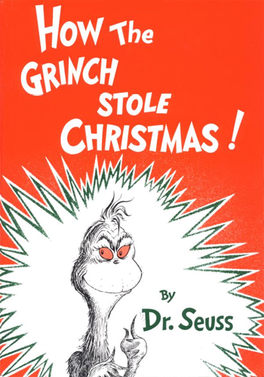
Arguably the most well-known children's book author of all time, Dr. Seuss has created unforgettable stories like Green Eggs and Ham, The Cat in the Hat and 1957's How the Grinch Stole Christmas, a holiday-themed treat starring my very favorite color, green. 

It's because the Grinch is green. He's the hero, or anti-hero, of the story, and he's a good one. He lives on a mountain above Whoville, where Christmas is celebrated with gusto. The Grinch hates the Whos. They sing, they dance, they exchange presents and eat food -- they annoy him. So the Grinch decides to take away their celebration, and steal Christmas.

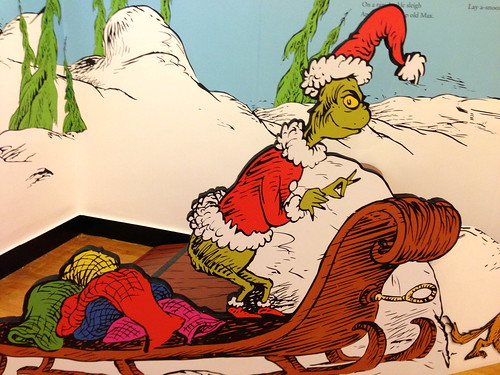
A bold plan. To carry it out, he's going to need a red suit. If you're wearing a red suit and screwing around underneath trees on Christmas Eve, people are going to think you're Santa Claus. This is just simple logic. It follows that he's also going to need a sleigh -- that's to hold the presents -- and a reindeer. A sleigh and a big bag, you can pretty much find that at any hardware store. But a reindeer...this requires several days of intensive tracking and hunting in the northern territories, and clearly the Grinch doesn't have this kind of time. So he puts an antler on his dog instead, a handy enough solution in a pinch. 


And the Grinch steals Christmas. He goes down into Whoville in the middle of the night. He takes their ornaments, their stockings, their brightly-wrapped packages, even the roast beast they're saving for the Christmas dinner feast. Yeah, that's right -- he takes it all, down to the last scrap. During his night of silent, Christmas-stealing terror, the Grinch encounters just one witness: Cindy Lou Who. This little Who wakes up to find the Grinch in her home, but all is well on account of the red suit (proof of the unimpeachable logic). Cindy Lou thinks he's Santa, and the Grinch pats her on the head...and sends her back to bed. 

Don't worry -- there is a surprise ending. The Grinch doesn't simply go back to his mountain and laugh the day away, or anything like that. If you don't know the story, I'm officially shocked. It's very well-known, highly popular...and the entire basis for an adaptation that's already 60 years old. Even if you've never seen the book, you probably know the book.

The Films

A 22-minute TV special is one of the best-known adaptations of the story. Look for it on TV during the holiday season, and you'll find it. 

Dr. Seuss himself worked on the animated adaptation made in 1966. He wasn't really into the idea at first, but after seeing some animation and hearing some of the songs he agreed. Seuss wrote the lyrics for the songs and the extra lines in the story himself.

He didn't narrate it, though. That honor was given to Boris Karloff, who had a perfect voice for this particular story. Thurl Ravenscroft sings the theme song that's such a big part of the adaptation. The animation is very true to the original illustrations in the book, and the narration is almost exactly the same as the text of the book.

How the Grinch Stole Christmas wouldn't become a feature film until 2000, when Ron Howard turned it into one. But turning a very short children's book into 90 minutes of film...takes a little stretching. 

The feature-length film begins beautifully, with narration by Anthony Hopkins that lifts Dr. Seuss's words straight from the page. The viewer meets the Grinch, played beautifully by Jim Carrey, who looks just exactly how he ought to look (only three-dimensional, and not animated). He's up in his mountain home damning the Whos who live down below. 

Then, we get to meet some of those Whos. The movie takes us down into the village in the days before Christmas, where we meet Cindy Lou Who and her parents. There are other characters as well, like the Mayor of Whoville and Martha May Whovier. The Whos look just as they ought, and they're frantically celebrating the season by shopping, decorating, shopping, decorating, and sending Christmas cards and packages (presumably, to the Whos who live in Whotown and Whocity). 

In a word, it's fabulous. No detail was left out. The film is lavish in all matters of set design, costuming and makeup. The dialogue is first-rate as well. Because there simply isn't enough story to fill an entire film, more has been added. Viewers are exposed to the Grinch's back story, and we even uncover a love interest. Cindy Lou becomes a fully-realized character, whose goal is to find the spirit of Christmas and get past all the obsessive shopping, decorating and eating.

New songs are added, and the original Grinch theme song is punched up a little. The scene of the Grinch stealing Christmas is perfectly re-created from the book to the film. It is one of the top five top-grossing holiday films of all time. Yeah, it's that good. If you haven't seen it, see it. If you've already seen it, see it again. It's the holidays, and green's the color of the season.

Writing 101: Conflict and Obstacles

If your main character doesn't have conflict and obstacles to overcome, then your story probably isn't complete. In life, things get hard. The going gets tough. Enemies appear. I want to see that in your book...and then, I want to see the main character defeat them. This is why your main character is also known as the hero


Nobody Said Life Was Fair

Here's the thing: you want readers to identify with your main character. Nobody's life is just perfectly smooth sailing. We all get crushes on people who don't like us back, spill something on ourselves at the worst possible time, get caught in the rain or in an embarrassing situation. Some people face extreme challenges, and often these make for the best stories. 

If your character faces no obstacles and lives a life free of conflict, I'm not going to find it believable. Even worse, I'm probably not going to like this character. Conflict and obstacles are an essential part of every plot. You don't necessarily have to have a villain, a character in the story who opposes your hero, but you do have to have something that keeps us from our goal. If the character is trying to solve a crime, put a nosy so-and-so in the way. If the character is trying to be prom queen, put an opponent into the mix. Or, mix it up and don't use a character at all. Maybe something happens to the main character with no outside help -- the hero falls and breaks a bone, and now they're physically limited. Conflict comes in many forms, and writing is a great way to explore it. 

Everyone faces challenges, and your main character should have the same experience. It's most rewarding to readers when the hero overcomes those challenges in order to get to their ultimate goal. Removing these obstacles shouldn't be neat and easy, because life so rarely is. Perhaps it's a story about a girl who's in love with a boy, buy he's got a girlfriend already. She's an obstacle. The more difficult she is to remove, the more rewarding it's going to be when she's finally out of the way. The struggle is the story, and that's what great writing is all about. 

You've already got everything you need to write about conflict and obstacles when you're writing fiction. As a writer, you've already faced all sorts of challenges in picking the right words, in facing your own fears, in finding courage and even in facing down those who oppose you. Now, go write about it.

Writing 101: Should You Ever Give Up?

I was inspired by a hashtag that I just happened to notice when I went to write this post, but it's a thought I've had before. It's easy advice to say "don't ever give up!" "follow your dreams!" and all that other inspirational nonsense, but it can be hell to live it. It's also unrealistic. Should you ever give up? Well yeah, maybe. 


A World Full of Books

This past year, 2012, which is nearly over (but not quite), more than 2 million new books have already been published. Just this year. In the United States alone, approximately 400,000 books have been published this year (10 Awful Truths About Publishing). That's wonderful, a great testament to the popularity of reading and literature. We are preserving a record. We are creating entertainment.


Judgment: Now Available!

Judgment (Deck of Lies, #4) is now available for Amazon kindle! The book will be available for Nook and other devices later this week, so keep checking back for links. 


Cashing Out

Do I swear to tell the truth, the whole truth and nothing but the truth?

How can I, when the truth will destroy us all? Now that I’ve started telling lies, I can’t stop. Not until all this is over, and I’m free of the family that never felt like mine. Maybe it’s wrong. Maybe I’m a bad person.

But it’s definitely the only way I’m ever going to escape them. I have to take the opportunity, no matter how terrible it is…don’t I?

Writing 101: No Writer is an Island

When I was very young, and dreaming of becoming a writer, I had a vision in my head of what it would be like. I would sit in a very quiet and serene room, all by myself, just creating brilliant words all day long. Now I know that sort of thing isn't possible -- and I'm pretty sure I wouldn't want it if it was. If you're self-publishing, you're doing a whole lot of work all on your own...but you probably aren't actually alone. Sometimes, it's hard to remember that the people around you are always contributing, too.


Hey, There Are Other People Here

Plenty of self-published authors don't live alone. They may have pets, or kids, spouses or roommates. All of these animals and people are capable of affecting the way you write your book. The people closest to writers are usually a big influence; certain characteristics from your mate may seep into the characters you put on the page. But they influence and affect you in other ways, too, and their contributions can't be overlooked. 
  • Space
The people who share your space with you make a difference, both good and bad. Make sure they understand that you need your own space to work and write, and really shouldn't be disturbed. And tell them how much they mean to you, from time to time. When the people closest to you are supportive of your efforts, you'll feel a lot less stressed about self-publishing.
  • Time
You need your friends and family members to give you the space to write, and that means you've got to give them something, too. Don't forget to make time for the other members of your household and others who are close to you. Do not spend all of your free time writing, though it is compelling to do so. Make time to maintain a social life, or at least something like it, and always take some time just for yourself while you're at it. Everyone has to recharge and reset, and you cannot think about writing all of the time. You'll burn yourself out, and make yourself nuts. 
  • Sharing
The people in your immediate household are your best sounding board. Ask them to read your work, bounce ideas off of them, get their input and their help. They're going to be much more gentle with you than any reviewer, and they're a wonderful first test for any ideas you have. If you're thinking of something that sounds really out-of-the-box, check it against those close to you and see how they react. 

There are other people in your life, and they can tell you that living with a writer isn't easy. Talk to them to let them know your needs, but don't forget to ask about their needs as well. Use them, appreciate them and get support from them. Your writing will be better for it, and your relationships will be a little less strained when you're slaving away at the keyboard.